The Advanced Pivot
Reframing the striker's role as a reference point for attacking against man-oriented defenses

I’ve been toying with the concept of strikers/center forwards deployed in something I’ve coined as the “advanced pivot” role. Conventionally, we associate the “pivot” role with deep-lying midfielders. It’s easy to envision what pivoting is from that position - receiving passes on the half-turn, deciding when to change the direction of possession, horizontal passes. You might picture Jorginho in your mind’s eye. Imagining a striker as a pivot may seem unconventional.
Take the noun Pivot and the verb Pivoting literally:
Pivot: the central point on which something rotates.
Pivoting: to turn or rotate from a central point.
I am no basketball expert but some research will tell you that a Pivot in that sport is an attacking player who stands with their back to the basket to catch the ball under pressure and give it to other attacking players. This is the conventional football-specific “pivot” role reversed - instead of facing the opponent’s goal (as the deep-lying midfielder would), the basketball-specific pivot has their back to goal/basket (as an advanced attacker would) - hence the term “advanced pivot.” I like the sound of “high pivot” also but let’s stick with advanced pivot for now.
Now in your mind’s eye you might see how a striker could operate as an advanced pivot. Intuitively, you might imagine a big and strong target center forward receiving long passes with their back to goal (nice parallel to the Center position in basketball) - a classic Target Man. And you’d be correct to assume that some target striker profiles offer good suitability for our currently undefined advanced pivot role.
For me it helps to reduce football-specific concepts such as a *role* to its atomic essence. I tend to take a functional perspective to avoid semantics and misinterpretations (because there are infinite interpretations). Also, because a role is defined literally as “the function assumed by a person in a particular situation.”
Essentially, the advanced pivot is a central attacker operating in front of the defensive line that acts as a reference point for pivoting the direction of attacks.
This role isn’t new. Center forwards have been used in this role in both a contemporary and traditional context but perhaps it’s nice to attach some specific nomenclature distinct from target men, hold-up strikers, false 9s, etc.
Naming is useful in a practical context. Attaching a specific term to a function shapes how it is perceived and verbally expressed. It makes a clearer reference that sharpens the lens through which player profiles are discussed. It can also serve as a shared reference for transmitting tactical information from coach to player.
Note that this definition does not mention style or technique, just function. It is intentionally concise and basic. I am allergic to boxing unique individuals in or out of top-down, highly specific roles. This way, my scouting and analysis lens is open to maximum variability. Infinite variations of technique and style can execute a single function.
In reality (because the human body has biological limitations), functional technique is clustered into sets of relatively similar movement patterns because those technical variations are simply the most effective and efficient way to execute a specific function (skill) for most humans (players).
Applying this concept to the advanced pivot role, you’ll find there are some player profiles that generally offer good suitability for “a central attacker operating in front of the defensive line that acts as a reference point for pivoting the direction of attacks”
If a player’s unique profile affords specific skills that are relevant to a specific role’s function, then that profile is probably a good fit for that role. However, this doesn’t mean a player cannot also play in different roles and execute different functions. Throughout this article, I will classify certain individuals as advanced pivots but that isn’t to say the advanced pivot role is what they are. It would be a crime to reduce Harry Kane to just pivoting (although he is world class at doing so).
I have (crudely) divided the advanced pivot role into a dynamic type and static type. Both offer different methods for fulfilling the function of pivoting (redirecting) attacks.
Dynamic:
Frequently adjusts position to create separation from markers.
Pivots play with varied actions - passes, dribbles, flicks, turns, combinations.
Ball-handling and spatial awareness allow for multi-directional attacking play.
Static:
Fixed body position in close contact to seal defenders and protect the ball rather than create separation.
Pivots play with bounce passes, minimal touches, good timing, and strong use of the body.
Body is primarily facing away from goal.
This dynamic-static divide is also a useful differentiator for deep-lying pivots. You can differentiate anything between dynamic and static. Robert Pirsig writes about this.
You might be brainstorming a few top level players to act as references here. In doing so, you might realize that dynamic advanced pivots are harder to find (and tend to be better overall) than static advanced pivots. You might also get the sense that dynamic types can also execute similar actions as the static types (albeit sometimes to a lower quality), but not the other way around. I think similarly.
General game theory would say that creative and unpredictable (dynamic) attacking actions are harder to defend than patterned and predictable (static) actions.
I see the static types as specialists - capable of executing a unique but narrow set of actions to a high degree of quality - and dynamic types as generalists - capable of executing a wide set of actions to varying degrees of quality. In the context of systems, generalists are flexible and specialists are dependent.
I have gone down the generalists vs specialists rabbit hole many times but I will avoid exhausting you. You could probably infer my answer if you read on.Let’s dig into to the advanced pivot’s place in the ever-changing tactical landscape. Don’t worry, I will eventually use actual players (and video) as examples instead of just discussing theory.
Everyone loves to talk about man-to-man pressing (or hybrid pressing in some cases) becoming the meta-defensive system. And they are right to do so. It is not hyperbole or prophecy to suggest its emergence as status quo. It is a macro-adaptation to counter positional attacking systems. The same way positional attacking systems emerged on a macro scale to counter zonal defensive systems.
This is what I call The Pattern:
Status quo is displaced by a dynamic disruptive system; that disruptive system is adopted and mimicked enlarge, turns static and becomes status quo. Then inevitably another dynamic disruptive system emerges and again displaces the status quo (which was the previous disruptive system). And this sort of goes on and on and on. Robert Pirsig also writes about this. The same in the ebbs and flows of civilization as it is in the cyclical nature of tactics.
The point I’m getting at is: the next era of dominant attacking styles/systems will likely be determined by their effectiveness to counter man-oriented defenses.
Changes to status quo won’t start at the top of the game but thematic shifts are evident even among positional ideologues like Pep and Luis Enrique. The underlying positional attacking logic remains but new methods are required to counter defensive styles that have adapted to defend positional attacks. But certainly, coaches who restrict their players’ movements to only specific zones of the pitch will not dominate this next era.

This is an interesting topic but I am going on a tangent now, so let’s get back to advanced pivots and why they are useful against man-to-man pressing schemes.
Man-to-man pressing (and man-oriented defensive systems in general) aim to deny space/time within each opponent’s immediate vicinity, no matter their position on the pitch. I could expand a bit more but for the sake of brevity, I assume you see the logic. Obviously, some liberties are taken - if I stand on the corner flag, my man-marker probably doesn’t need to be touch-tight. When man-marking, the opponent’s position is the highest order reference in the defending player’s perceptual schema for decision-making.
Man-marking is difficult to play against because it is difficult to occupy space. If you move into space, your marker follows. Without the ability to occupy space, you must arrive into space. Or, you ignore all this talk about space and simply play without it - it is not absolutely necessary for effective attacking play.
We can pull two key attacking themes for countering M2M defending - dynamic arrivals into space and attacking without immediate space/time.
Both methods overlap with the core principles of the dynamic and static advanced pivot types. Let’s break down each one.
Dynamic Arrivals In Front of the Defense
Originally, I titled this section “Dynamic Arrivals” to keep it concise, but technically, we are looking at arrivals in front of the defensive line, not behind it or around it. As defined earlier, advanced pivots primarily operate in front of the defensive line and behind the middle line of the defending team.
A Dynamic Arrival in Front of the Defense is:
Dynamic: Unpredictable movement timing to create momentary separation from a marker
Arrival: Moving into space to receive the ball in motion before a marker can close the separation gap.
In Front of the Defense: Dropping from the last line into areas in front of the defense and behind the opponent’s midfield.
The image below depicts a common situation where dynamic arrivals in front of the defensive line can be effective for countering man-to-man pressing.
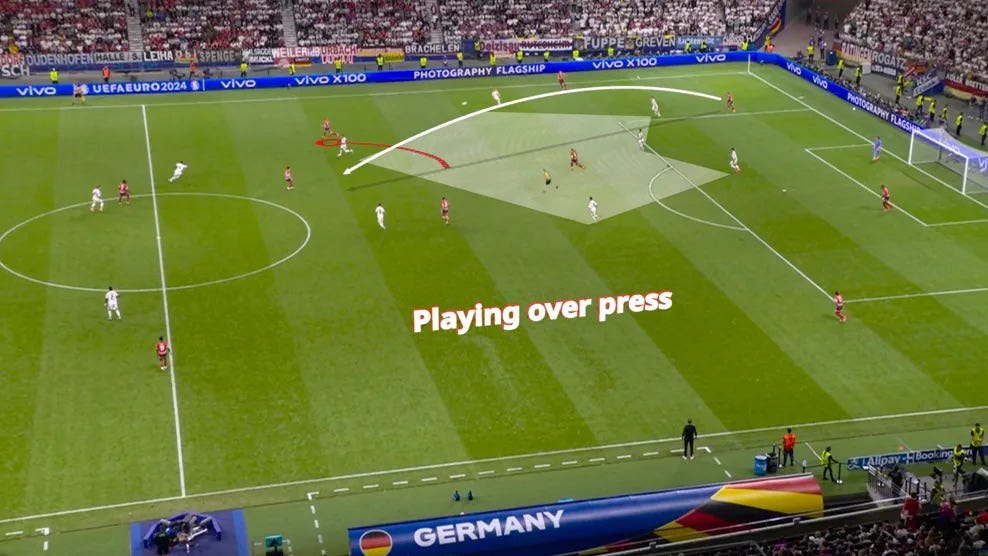
Deep build-up is a logical opportunity for pressing teams to match their opponent 1v1 across the pitch because of the larger distance away from their own goal, and the shorter distance to the opponent’s goal. A favorable risk/reward ratio. The risk: opponent winning a 1v1 duel and disrupting the entire defensive organization. The reward: winning the ball close to goal.
From such a deep position, it will be difficult to find passing lanes to an advanced pivot arriving dynamically, so it makes sense to play over pressure to avoid interceptions in dangerous areas.
It is not an easy task to control an aerial pass while moving at speed and with oncoming pressure, but profiles with advanced pivot qualities function well in these situations. Static types can secure possession with minimal touches and resist contact pressure. Dynamic types can control the ball and manipulate it to escape pressure. And if you have a player capable of handling these situations, why not utilize them frequently?
I predict more teams will lean into this attacking pattern.
The clips below show a dynamic arrival variant in action. These seemed unconventional initially (which is what piqued my interest), but effective with the right profile of attacker.
The oddity of these sequences makes me think they were explicitly instructed, rather than organically coordinated. That’s my assumption. I also assume that the frequency and quality of these sequences will improve significantly once teammates can collectively perceive these opportunities without top-down instruction, when they become self-organized.
The first two clips are of Dion Beljo (then of Rapid Wien, now of Dinamo Zagreb). The last clip is Jusef Erabi (then of Hammarby, now of Genk). Both players I’d categorize as static advanced pivots - strong receiving direct passes under high pressure. Both players with stocks on the rise (in my opinion). Maybe not a coincidence.
Attention to the midfield dynamics also. Midfielders help create the space to arrive into, they also must arrive dynamically themselves. This topic itself could be its own article. We’ll talk more about this later.
Dynamic advanced pivot types are also worth noting here, but generally we see them ‘floating’ into space dynamically rather than arriving intensively. This movement style aligns with other aspects of their skillset, specifically ball-handling and body fluidity. It would be difficult to twist and turn when receiving the ball running towards your own goal. So more often we see dynamic types receive to feet moving at lower speeds, but they still arrive deceptively (dynamically).
I’m a big fan of Joshua Zirkzee. He is a unique combination of size, elegance, and deception. I’d classify him as a dynamic advanced pivot - excellent ball-handling, pressure-evasion, and associative perception from central zones in front of the defense. More of a ‘floater’ rather than positionally fixed on the last line like most static advanced pivots.
Dynamic advanced pivots aren’t considered dynamic solely based on their movement speed and frequency. Dynamism comes in the form of unpredictability and deceptive actions - either on an individual level or group level. When you pair these profiles with mobile attacking teammates in proximity, connections form and good things happen, against any defensive orientation.
For the Dutch national team, we get to see Zirkzee paired with (also in my opinion) the best combination-creating, space-finding attacking midfielder in the world, Tijjani Reijnders. They are a cheat code. See below.
Clear synergy. Look how many decisional dilemmas and miscommunications they create for the defenders. This is a clear reference to the synergetic effect between dynamic advanced pivots and mobile attacking midfielders when closely positioned.
Yes, I know Zirkzee has not succeeded at Manchester United. Unsurprising, considering that team has no intention of attacking through the center. Also, when key aspects of a player’s ball-handling deception are oriented around faking passes, they will inevitably be less deceptive when teammates aren’t in nearby positions to pass to. Who would you fake a pass to? The wingback positioned 50 meters away? Defenders aren’t stupid. I think Zirkzee will go on to succeed at his next club.
Let’s move on to the next method. No one wants to hear about Manchester United. Everything has already been said.
Attacking Without Space
Football fans, coaches, analysts, and players are all conditioned by space and time and finding the ‘free’ player. We instinctually assume the ball should be played to the players with sufficient space, time, and separation from opponents. It feels intuitive.
I remember a quote from Marti Cifuentes (formerly QPR manager, now at Leicester) where he says,
“So that’s what we try to do through positional play. It’s to try to find where there is more time. Time is everything. Time is space. Time is more quality to execute, even for an average player.”
Disagreed. By this logic, less time would mean less execution quality. And no time would mean no quality. That logic seems flawed.
I don’t think time is everything. Certainly, time can be an important precondition for execution quality, but by no means is it absolutely necessary. I can guarantee that some of the highest quality attacking actions you’ve ever seen have come from situations where a player has little to no time/space to execute. That is because those actions were intuitive. I’ll stop before I head down another rabbit hole. Daniel Kahneman writes about System 1 (fast, intuitive) and System 2 (slow, deliberate) thinking in Thinking, Fast and Slow.
Back to the point. Now, maybe you can understand why man-oriented defensive systems have been highly disruptive to positional attacking systems. If your attacking logic is similar to Cifuentes (more time = more quality), how do you create attacking quality when the opponent intends on denying as much time/space as possible with man-marking?
Perhaps, you’ll choose to stretch the pitch as big as possible to maximize time/space. That is how you end up with your best dynamic attacking threats pinned within 3 meters of the touchline for 90 minutes and central attackers completely isolated. Or maybe, especially once opponents are athletic enough to man-mark across the pitch, you realize you don’t have a logical answer within your conceptual scheme. So, you optimize for alternative methods of scoring and winning, such as long throws and set pieces. That is where the 25/26 Premier League season is currently. And I am patiently waiting for evolution, which is inevitable (hopefully) in such a competitive landscape.
The next few years of football will consist of a nontrivial number of practitioners realizing that time/space is not fundamental to high quality attacking play. It never has been. Yes, it is a useful precondition for attacking quality, but not completely necessary.
So how do you attack without space? You’ve read this far, so I’m assuming you’re thinking of static advanced pivots, similar to what is known as Target Men™.
Static advanced pivots are effective despite being man-marked. They can execute with quality under high contact pressure. It is a safe bet to assume they will play an important role in the next era of attacking systems. But it will require some conceptual de-patterning to perceive affordances without a ‘free’ player with time and space.
Let’s look at a few examples.
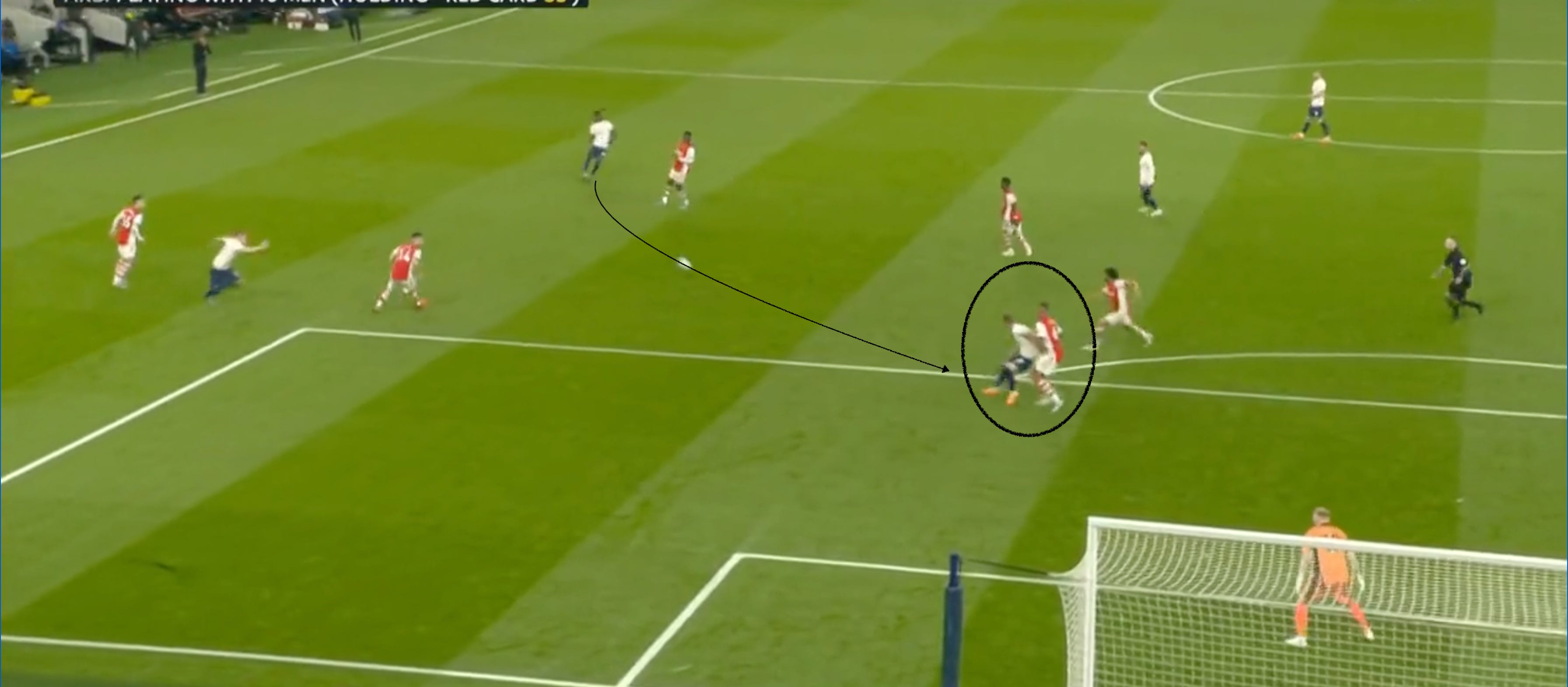
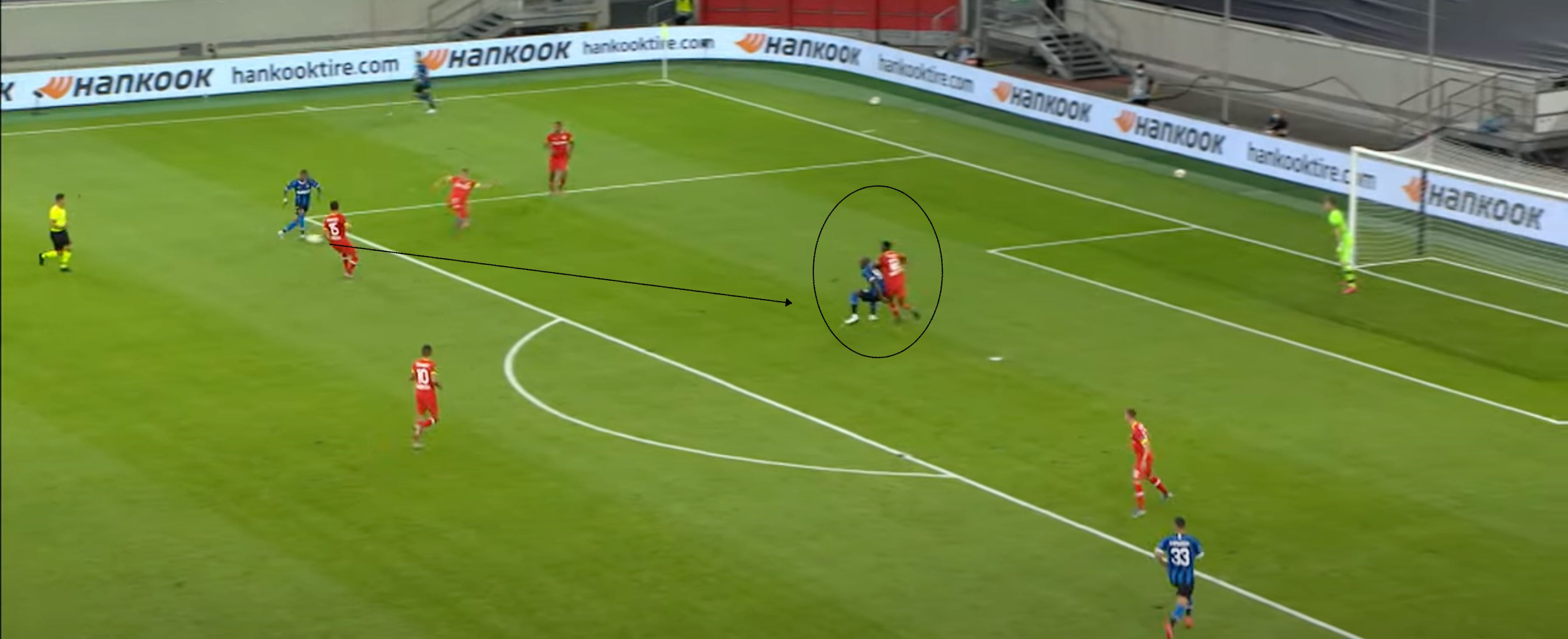
I love this type of pass. Basketball are again ahead of the curve with the concept of “posting up.”
The missing micro-skill here is what they call a “seal” in basketball (or so I’m told).
The seal is the act of securing body position in front of the marking defender, sealing off access to the ball-side space so the defender cannot access the passing lane without going through you.
These passes (if you can create the conditions for them) open up a wide range of attacking possibilities, plus streamlined access to the box. As a defender, this is an uncomfortable and vulnerable position to be in, even when intensively marking. If you can create these 1v1 situations in the box, the attacker has an unfair advantage - the fouling threshold is higher for them, and the risk of fouling is lower; defenders have to exercise extreme caution.
Granted, not every attacker has the physical capacity to pin strong central defenders this effectively. But if you have a profile with advanced pivot qualities, why not try this all the time? In my hypothetical attacking style, when our big striker (static advanced pivot) sets up to pin the opposing defender in a 1v1 situation, that is a massive cue for the rest of the attackers to organize in relation to the striker’s position for bounce passes, flicks, sets, etc.
You can think of the seal as the precondition that makes those bounce/flick/set passing sequences structurally repeatable against man-oriented defenses. If the striker consistently wins the ball-side passing lane (even for a second), the team can reliably play through man-to-man contact rather than around it.
This is what it might look like in action.
The movement following the entry pass into the posting player is excellent. That is difficult to man-mark. You can notice some parallels to attacking dynamics in basketball.
These dynamics are trained often but I rarely see them manifest like this in matches. However, I do think we’ll see them more in the future. It’s common to design small-sided training games with an end player fixed between two small goals or to the side of a big goal, restricted to a specific zone and a touch limit (often just 1). This primes the non-fixed players to perceive the deepest possible option, and move off the ball as the 3rd man to lose their marker and receive off the end player, similar to the clip above.
The obvious difference to those training games is the opponent reference. The fixed end player is strictly free without a marking opponent; that doesn’t exist in a match context. I think that’s a big factor as to why these dynamics rarely manifest. Players are conditioned to perceive and play towards a free player, not someone being manhandled by a defender.
Still, I’m bullish on “posting-up” and the “seal” as a method for attacking against M2M setups. Likely, we’ll see these dynamics occur more often in high density, small space attacks (like the above example). Attacks over short distances provide more affordances to play to marked teammates - less time for a defender to step in, less time and better conditions to execute pivoting actions (one touch passes, flicks, spins, etc) but that is by no means a rule, as we see below.
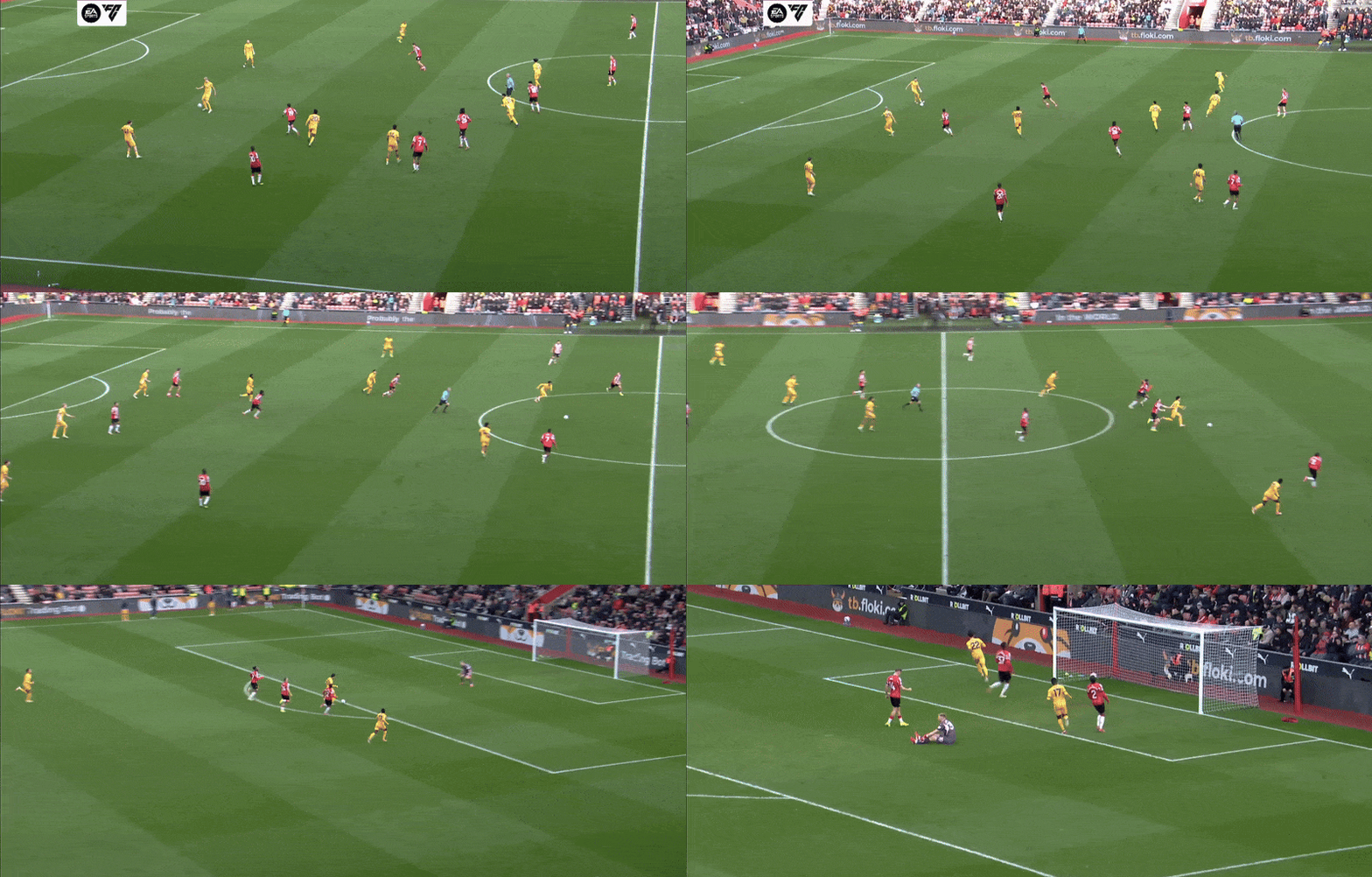
Attention to Mitoma here (the goal-scorer). His initial movement before Dunk’s entry pass clears a passing angle to Pedro, the deepest option. Once he sees that Dunk has perceived that angle, he is the first player to perceive the opportunity for a 3rd man combination. He beats his man-marker through speed of thought - all it takes is a few tenths of a second. 1v1 duels against a M2M opponent can also be won off the ball.
For me, João Pedro is a great dynamic advanced pivot. He can combine and escape pressure in deeper positions but he can also pin and play with opposing contact as we just saw.
The last summer window saw many big clubs pay big money for big strikers - Šeško, Gyokeres, Isak, Woltemade, Osimhen, Ekitike. Only some of those names I’d classify as being able to play in an advanced pivot role, but regardless.
Brian Brobbey is a big striker who moved this summer to Sunderland from Ajax for less than big money. He was born for the static advanced pivot role. The uniqueness of his playing style conditions his teammates to spot attacking affordances that they wouldn’t when playing with a different profile of striker - this has been the case since he was 16 and it has been fun to observe. In fact, many of those observations sparked ideas for this article.
Here he is posting up against the gigantic Jonathan Tah.
Attention to Gakpo from the left. Similar to Mitoma, he wins the positional battle because he’s quick to think and move. Ultimately, these off-ball movements are key to exploiting this attacking pattern. But also consider the secondary and tertiary effects of organizing an attacking style with these dynamics.
Central defenders hate to be exposed like this. Usually, they’ll shout for a second defender to give +1 coverage, or they’ll pull their central midfielders deeper to screen the entry pass. Both destabilize a man-oriented press. As a consequence, you force the opposition to adapt their defensive organization, or you keep exploiting an advantageous 1v1 match-up.
Attacking dynamics that provoke decisional dilemmas for the defense tend to be high functioning and effective.
Here’s another Brobbey clip (I have many).
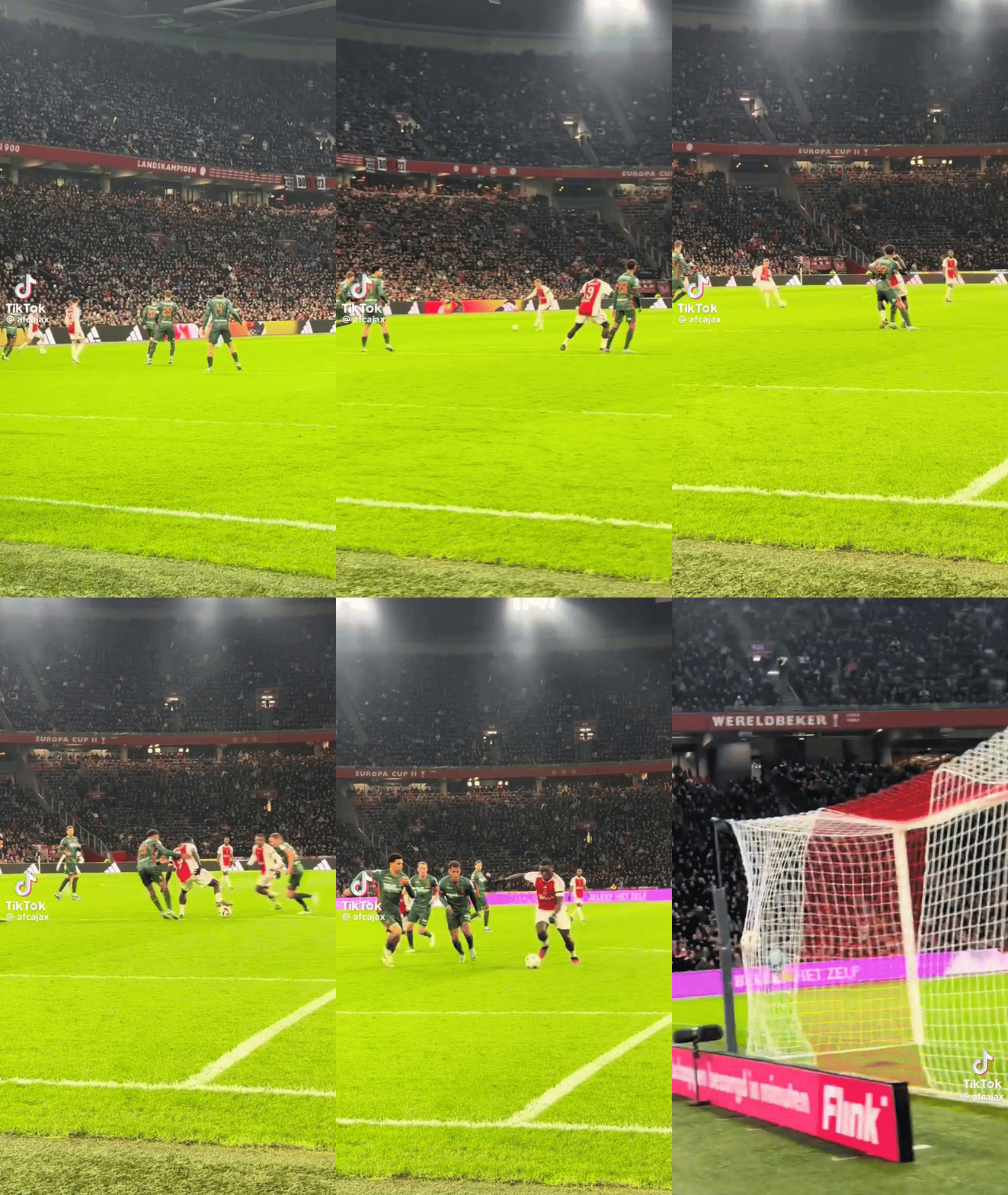
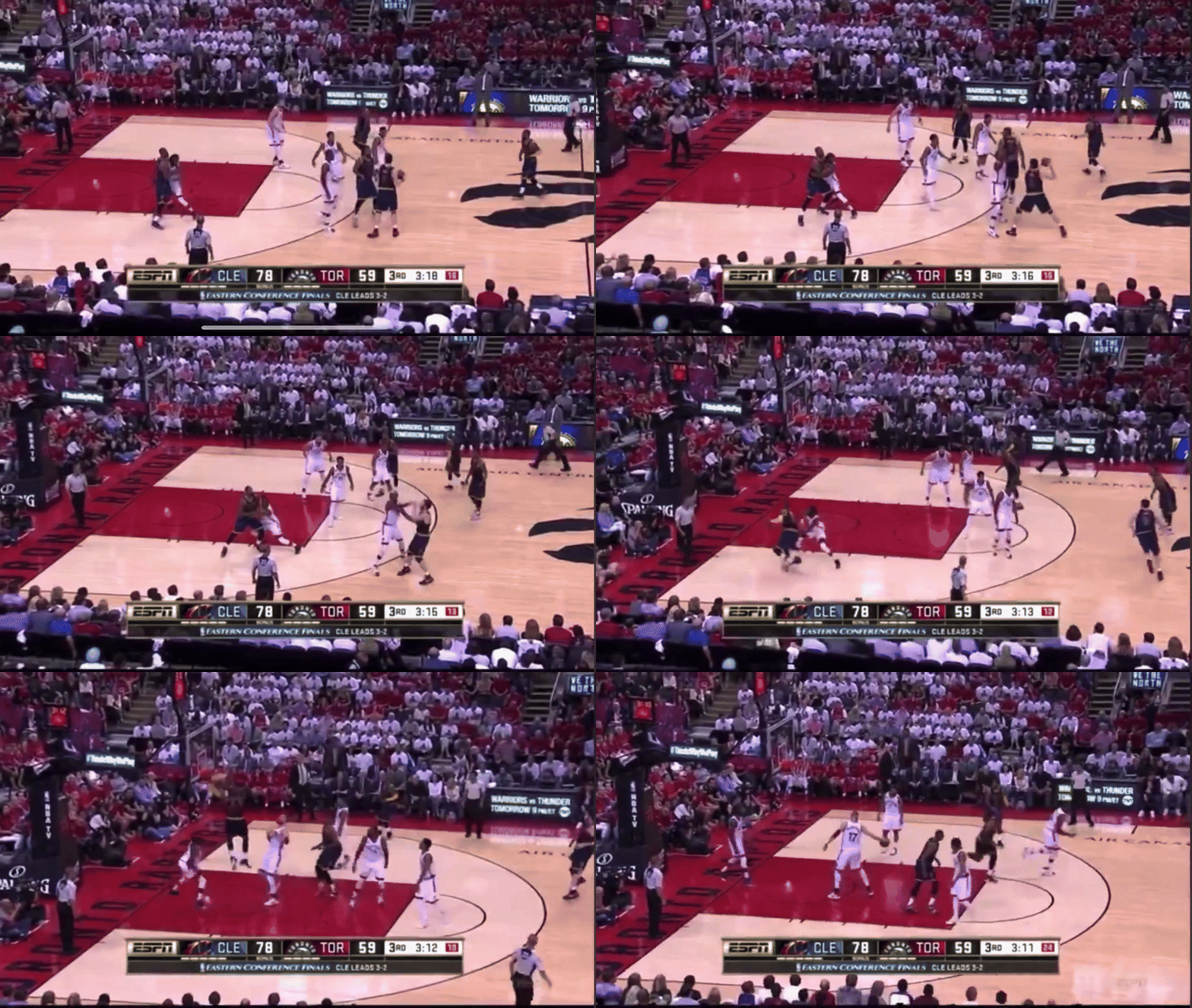
The similarities with basketball are obvious. He’s posting up. Eerily similar to what LeBron does in the clip below, except Brobbey’s goal counts the same as any other goal.
I’d like to return to this article in maybe a year to see if/how the advanced pivot concept has/hasn’t manifested. Please share if you come across any crumbs of evidence.
To conclude, here are the key takeaways from this article:
The Advanced Pivot role reframes the striker position as a central reference point for redirecting (Pivoting) attacks from areas in front of the opponent’s defense.
Dynamic and Static Advanced Pivot types represent two variations of the role: Dynamic types create separation through movement and deception, static types operate with stability and contact resistance.
As man-oriented defending becomes the status quo, teams that can attack effectively without immediate space/time will have the competitive edge.
Brilliant 👏 really enjoyed reading!